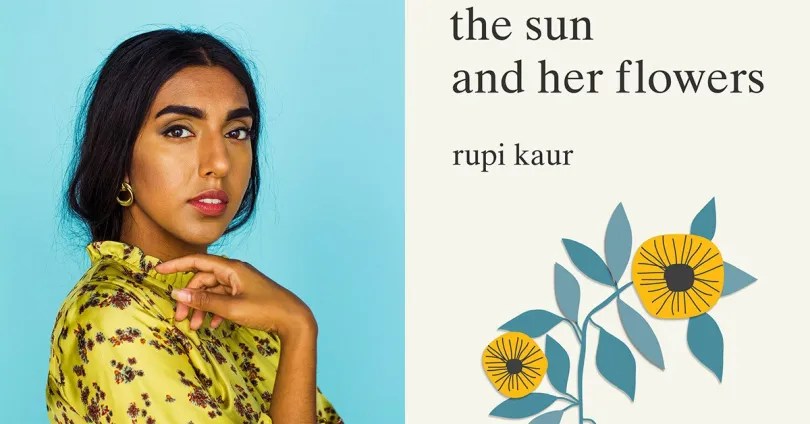
Some books are meant to be read, and others are meant to be felt. The Sun and Her Flowers by Rupi Kaur is one of those rare books that take root inside you. Divided into five sections—wilting, falling, rooting, rising, and blooming—it mirrors the life cycle of a flower, using poetry to explore love and heartbreak, migration and identity, trauma and healing. Each poem is a petal, delicate yet resilient, forming a collection that reminds us growth is often painful, but always beautiful.
Poems That Linger Like Wildflowers
Rupi Kaur has a way of distilling complex emotions into the simplest of words. Some poems are no longer than a sentence, yet they carry the weight of generations. In wilting, she writes about heartbreak with the raw honesty that made Milk and Honey so powerful:
“what is stronger than the human heart which shatters over and over and still lives”
There is something deeply personal, yet universal, in the way she captures loss—the ache of missing someone, the confusion of loving and leaving, the slow process of piecing yourself back together.
But The Sun and Her Flowers is more than just heartbreak. In rooting, Kaur shifts her focus to themes of immigration and ancestry. She writes about her parents, about the sacrifices they made so she could have a better life, about the way her mother carried a home within her:
“our knees pried open by cousins and uncles and men our bodies touched by all the wrong people and still we are the ones who feel shame”
This section is deeply moving, especially for readers who come from immigrant families or have ever felt disconnected from their roots. Her words carry the weight of displacement, of trying to find a home within oneself when the world doesn’t quite offer one.
The Power of Simplicity: Poetry and Illustrations
One of the most distinctive aspects of Kaur’s work is the way she pairs poetry with her own hand-drawn illustrations. The sketches are minimalist, almost childlike, yet they carry an emotional depth that complements her words. Some drawings depict women embracing, others show figures curling into themselves or standing tall, mirroring the themes of loss and self-discovery woven through the book.
In one of the most powerful combinations of poetry and art, she writes:
“the right one does not stand in your way they make space for you to step forward”
Next to it, a simple sketch of a woman walking forward, unburdened. The visual simplicity reinforces the emotional clarity of the poem, making it hit even harder.
A Book to Return to in Every Season
If Milk and Honey was an open wound, The Sun and Her Flowers is what happens after the healing begins. It is about learning to let go, but also learning to stay. It is about honoring the past while embracing the present. About remembering that no matter how much you’ve been uprooted, you can always plant yourself again.
Because everything that leans toward the sun eventually blooms.
Read it on a quiet afternoon. Let the words sink in slowly. And when you find a poem that feels like it was written just for you, hold on to it—let it take root.






 Le joy